My Projects
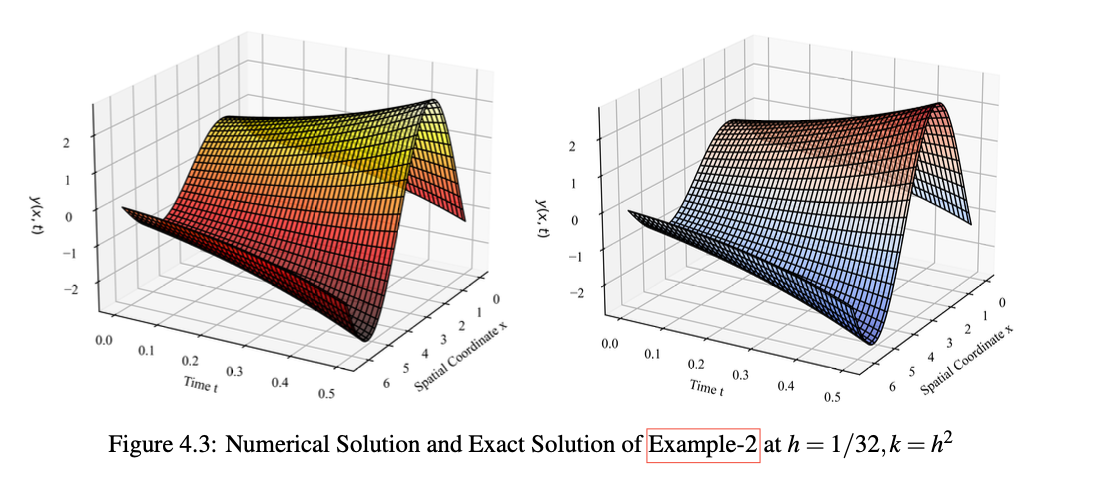
Compact Finite Difference methods for solving partial differential equations
Two fourth order CFDM schems were developed for heat and ADR equations
Supervisor : Dr. Harshita Madduri
A higher order numerical approach for solving 1-D parabolic PDEs, such as the Diffusion and Advection-Diffusion-Reaction (ADR) equations, is developed and studied in this work. The proposed approach uses the Crank–Nicolson traditional finite difference method (FDM) for time discretization and a fourth-order compact finite difference method (CFDM) for spatial discretization. The accuracy and efficiency limits of the explicit, implicit, and Crank-Nicolson finite difference methods (FDM) are highlighted in this we use operator-based and Taylor series techniques, a compact study is created to overcome these issues, producing a solution that uses fewer grid points while achieving higher accuracy. The stability of the scheme is analyzed using Von Neumann ( Fourier analysis). A comparative study of CFDM is conducted through Python implementation on a variety of problems involving diffusion, advection, and reaction with constant coefficients. The results show that CFDM yields more accurate and efficient solutions than traditional methods. The work concludes by outlining future directions, particularly the extension of the scheme to PDEs with variable coefficients, for which initial developments are underway.
Read More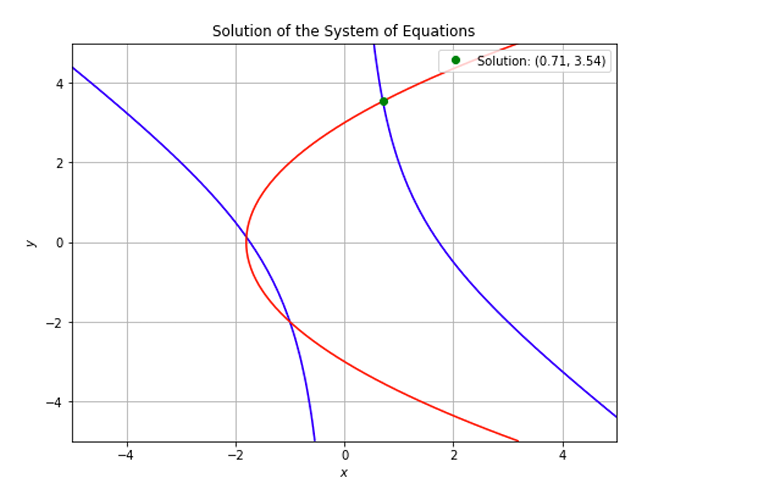
Solution of Non Linear Partial Differential Equations
Supervisor : Dr. Harshita Madduri
We solved various types of differential equations, including the Burgers’ equation, using Newton’s Method, Quasi-Linearization Method, and the Finite Difference Method (FDM). The implementation was carried out in Python, leveraging numerical techniques to ensure accuracy and stability in the solutions.
Read More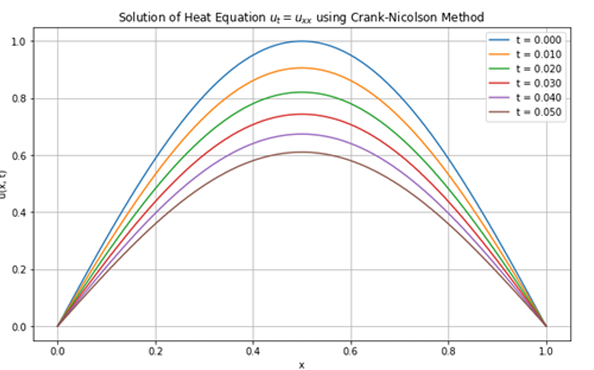
Comparison of method for Solution of heat eqaution
Supervisor : Dr. Harshita Madduri
We implemented the Heat Equation model using Explicit, Implicit, and Crank-Nicholson schemes and compared their computational costs. To solve the resulting Tri-Diagonal System of Linear Equations (SOLE) efficiently, we utilized the Thomas Algorithm and Sparse Matrix methods. The entire implementation was carried out using Python, focusing on accuracy, stability, and computational efficiency.
Read More